Gentle text neck exercises you can do at your desk or home, with step-by-step instructions, safety tips, and when to seek professional care in Utah.
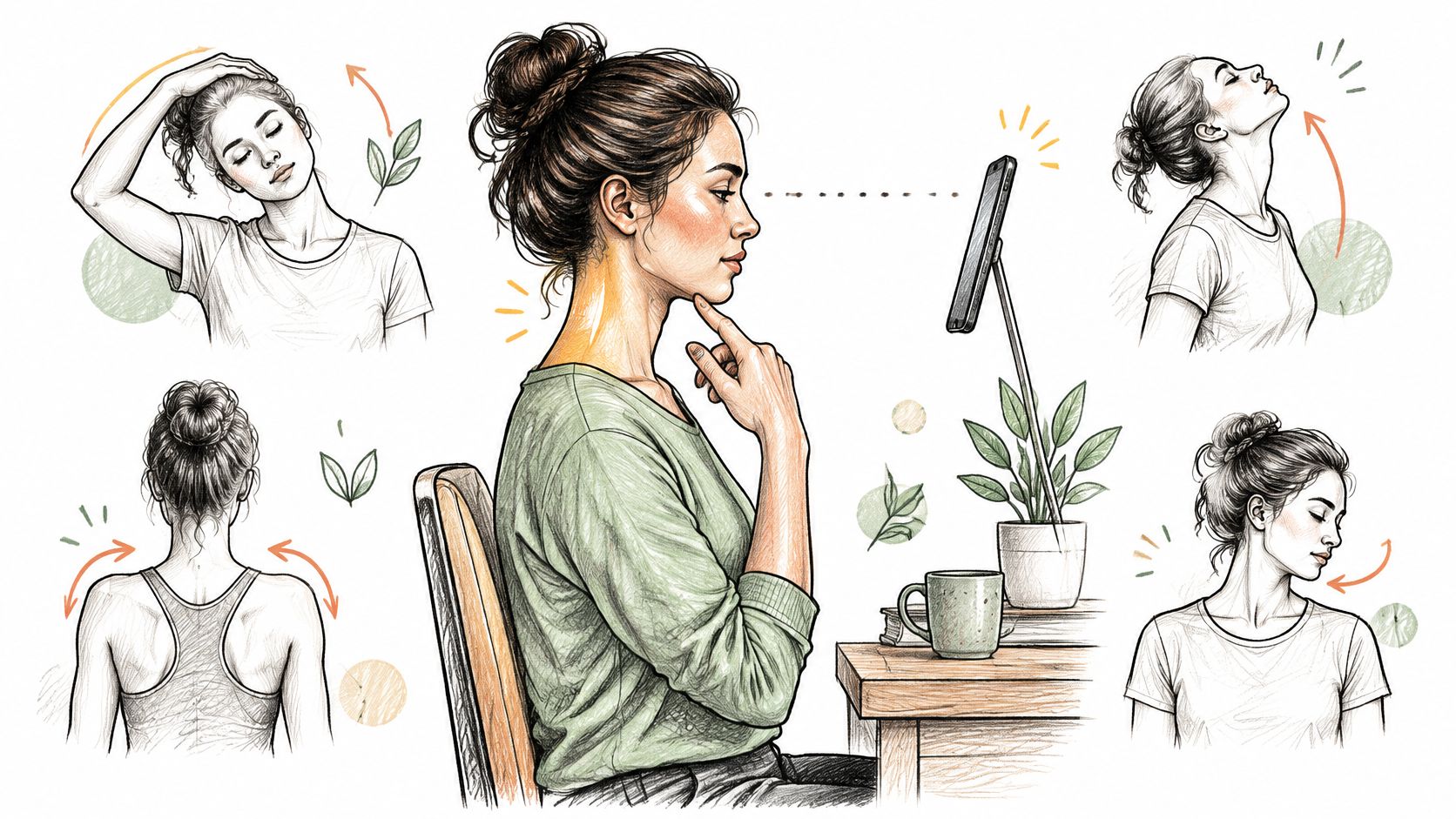
Your neck feels stiff before you've even stood up, and the phone in your hand is the reason. Eight hours at a laptop, then an hour of scrolling in bed, and by evening the base of your skull aches and your shoulders sit somewhere near your ears. As the head drifts forward of the shoulders, the muscles at the back of the neck and the top of the shoulders hold it up at a mechanical disadvantage, while the deep muscles at the front of the throat go quiet. Months of that pattern produces a tight upper back, rounded shoulders, and a dull ache that no amount of rolling your shoulders seems to fix.
The seven exercises below are organized by the specific driver each one addresses: forward head, rounded shoulders, a tight chest, a stiff mid-back, or lost neck motion. Each comes with form cues, a realistic dose, and the red flags that mean stop. A few symptoms need a clinician rather than a stretch, and those are flagged too.
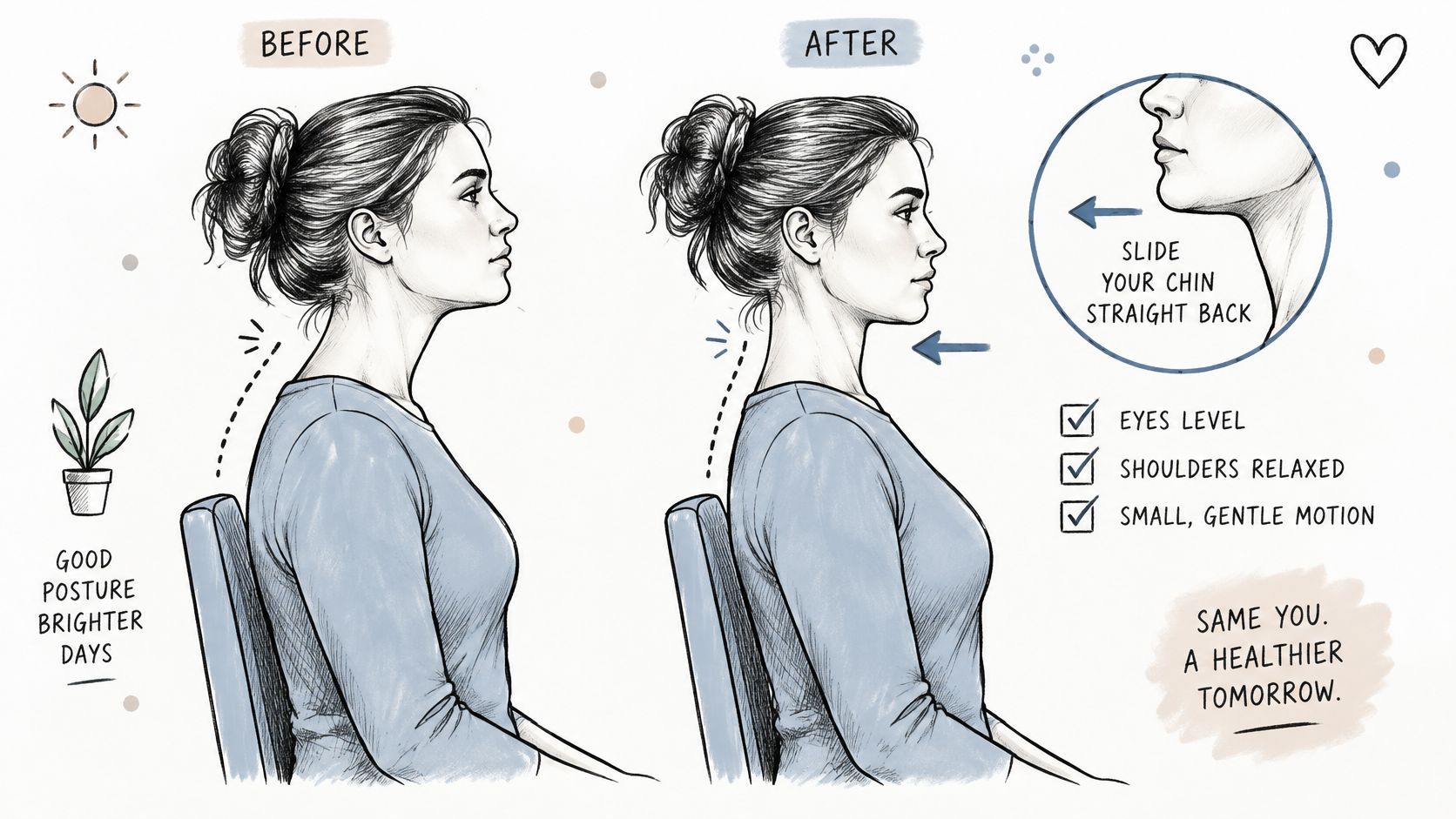
Chin tucks are the foundation of any text neck exercise program, and they're the one movement I'd keep if I could only prescribe one. The head slides straight back over the shoulders without the chin tipping down, which lengthens the suboccipital muscles at the base of the skull and switches on the deep cervical flexors that prolonged phone use has put to sleep.
A 2017 randomized trial of 32 people with forward head posture found every exercise group improved cervical range of motion over four weeks, and the group performing the program three times daily improved the most. Forward head posture itself also changed in that short window.
Form cues:
Office workers do well with 10 slow reps every hour during long computer sessions. The difference between a slump and a clean retraction is small from the outside.
Stop immediately if you feel dizzy, lightheaded, or get numbness or tingling into the arms. Those symptoms are not a sign you need to push harder.
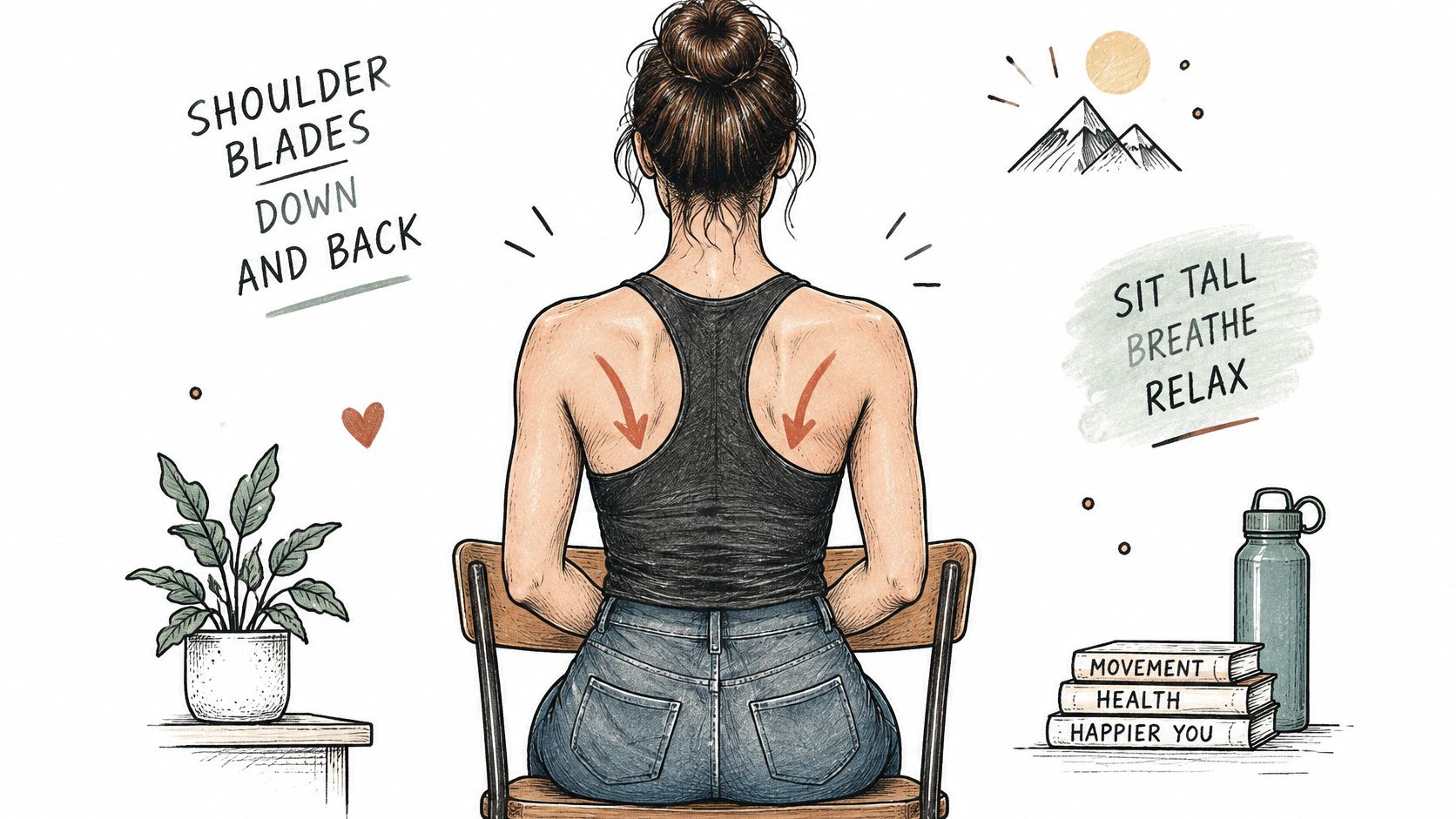
Rounded shoulders and a forward head travel together. Drawing the shoulder blades down and back recruits the middle and lower trapezius and the rhomboids, which gives the neck a stable platform instead of a sloped one.
A 2021 controlled trial of 46 people with forward head posture split participants into an exercise group and a knowledge-only group, with the exercise group training three sessions weekly for six weeks. Compared with education alone, they improved craniovertebral angle, cervical flexion-extension strength, neck flexion endurance, and pectoralis minor flexibility. That last detail matters: strengthening changed tissue length elsewhere in the chain, not just posture on a photo.
Think of pulling the blades toward your back pockets, never up toward your ears. Shrugging instead of retracting is the most common error and it feeds the tightness you're trying to calm.
Dose: 2 sets of 12 squeezes held 3 to 5 seconds, done during phone breaks. Progress to band rows when bodyweight squeezes feel easy.
Practical rule: If the squeeze produces a sharp catch between the blades or sends pain down the arm, stop. That's not a muscle working, and it needs an assessment before you continue. For a broader progression, work through these posture correction exercises.
People who stretch their chest for ten minutes a day but never strengthen the upper back may improve flexibility without changing the postural pattern. Tight chest muscles can draw the shoulders inward, making it harder to keep the head comfortably over the trunk.
A systematic review and meta-analysis of 10 randomized controlled trials involving 550 adults with forward head posture and neck pain found that therapeutic exercise improved craniovertebral angle by 3.38 degrees versus control (95% CI, 2.10 to 4.65), reduced pain by 1.42 points on a visual analogue scale, and improved neck disability by 5.44 points. Combined exercise protocols outperformed isolated exercises. Programs lasting eight weeks or longer produced larger functional gains. The evidence certainty was low to moderate, and results varied considerably, with an I² of 74.6% for posture.
How to do it: Place your forearms on a door frame, first at shoulder height, then around elbow height, then slightly above shoulder height. Step forward gently until you feel a mild stretch across the chest. Keep your ribs relaxed, breathe slowly, and hold each position for 20 to 30 seconds.
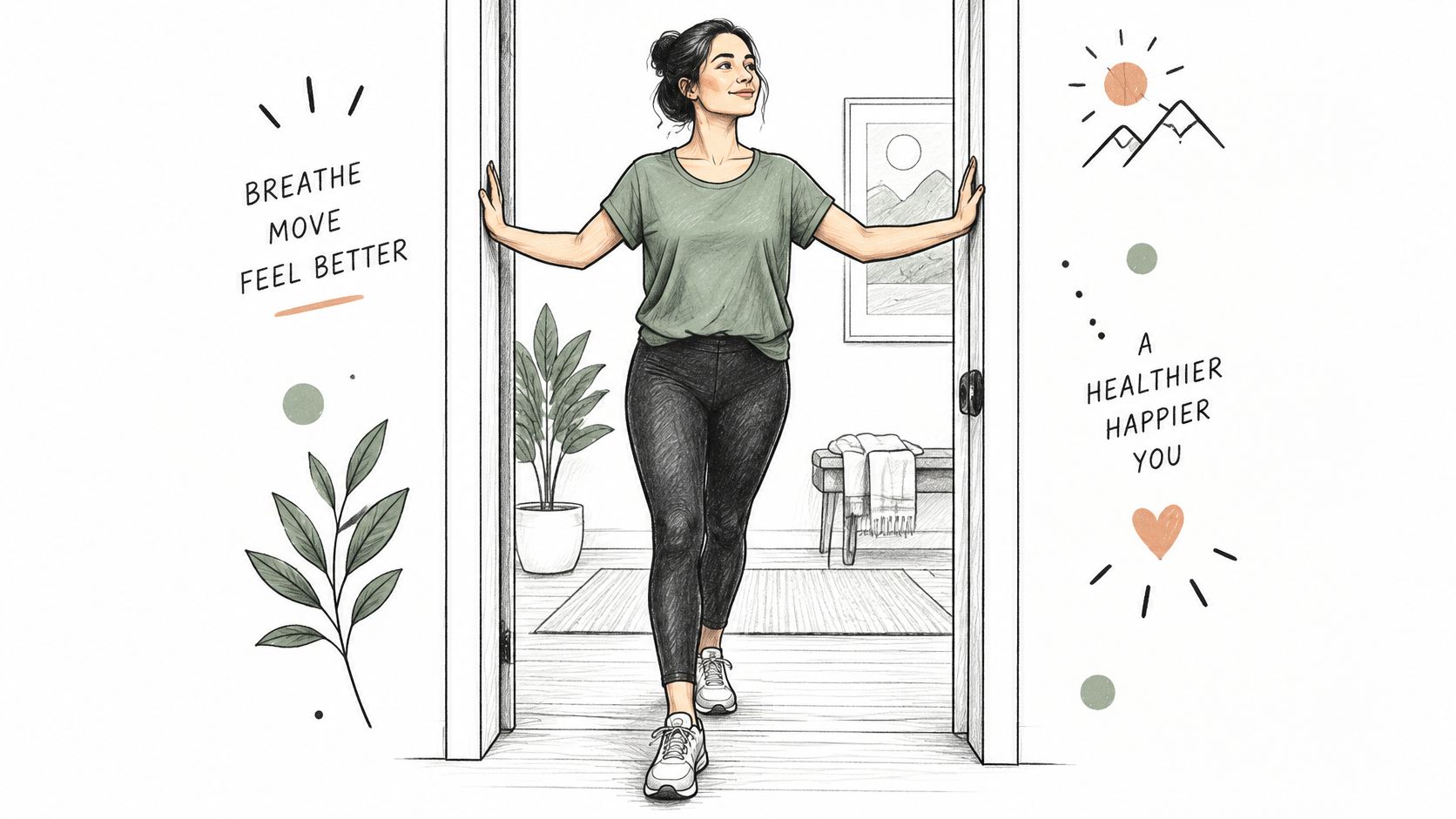
Ease out if you feel a pinch at the front of the shoulder or tingling into the hand. Stop if the shoulder catches or the symptoms persist.
If your headaches start at the base of the skull and climb over the ear, they often begin in these muscles. The upper trapezius and levator scapulae lift the shoulder blade and help hold the head up, so they carry the brunt of a long screen day. Chronic tension in them produces neck pain, headaches, and reduced rotation.
A clinical study of 60 smartphone users with chronic neck pain and forward head posture put 40 people through resistance and stretching work that included a static levator scapulae stretch, three times weekly for eight weeks, with 20 controls. The exercise group showed a reduction in pain. The control group did not.
Form cues:
Remote workers often use this one after long video calls, and people prone to tension headaches do well with it as a daily habit. These neck pain exercises at home fit around it.
Skip the stretch and get checked if it brings on dizziness, sends tingling down the arm, or makes a headache worse rather than better.
Your eyes stay level no matter what the rest of your spine does. When the mid-back stiffens into flexion, the head drifts forward to compensate, and the neck ends up holding weight it was never built to carry. Restoring thoracic extension gives the head somewhere to sit other than out in front of the shoulders.
The research case is solid here: in a meta-analysis of seven randomized clinical trials covering 627 participants with forward head posture, the pooled odds ratio for craniovertebral-angle improvement was 6.7 (95% CI, 2.53 to 17.9) and the pooled pain estimate was 0.3 (95% CI, 0.13 to 0.42) for therapeutic exercise. The reviewers rated the evidence strong for alignment and moderate for pain, while noting exercise did not clearly improve every alignment measure.
Setup: place the chair edge or roller at the bottom of your shoulder blades. Hands behind the head to support the neck, chin gently tucked, then extend back over it one or two segments at a time as you exhale. Keep the ribs down. If your low back arches hard, you are borrowing motion from the wrong joint. Do 5 to 8 slow reps, shift the contact point up a segment, and repeat several times a day. When mid-back stiffness refuses to budge, this guide to thoracic back pain lays out the next steps.
Skip this and get cleared first if you feel sharp mid-back or rib pain, have a known compression fracture, or carry a recent osteoporosis diagnosis.
Lost neck motion is the driver this drill addresses. Where chin tucks restore head position, rotation and side bending restore the degrees of turning that desk posture takes away, and the loss shows up in daily tasks like checking a blind spot or turning toward a passenger long before it registers as pain.
The research supports the work, within limits. A scoping review of the forward head posture literature turned up only 15 relevant studies, with promising results spread across corrective, stabilization, strengthening, Pilates, and proprioceptive exercise. Methods vary enough that no single routine earns universal status.
Forward head posture describes where the head sits, one observable finding on an exam. It says little on its own about why a neck hurts, and chasing a rigid "perfect posture" tends to increase guarding rather than relieve symptoms.
Dose: rotate and side-bend slowly in each direction, stop at the first point of firm resistance rather than pushing into pain, and do 5 reps per side twice daily with the chin level and shoulders relaxed. Drivers checking blind spots can run one set before pulling out of a parking space. Anyone recovering from whiplash should run it inside a monitored program, not solo.
I also use it as a check: compare left rotation to right, and note any clear asymmetry even when nothing hurts. Stop if the movement sends symptoms into the arm or produces unsteadiness, and get a recent collision injury examined before doing range-of-motion work.
Rounded shoulders and a stiff mid-back both steal the same motion: the shoulder blade's ability to rotate upward as the arm travels overhead. Wall angels train that motion directly, which is why they expose compensation so quickly. Chasing arm height instead of control is the usual way this drill goes wrong.
How often you practice carries as much weight as the drill itself. A 2025 systematic review of six randomized trials involving 381 participants found no significant overall pain, disability, or quality-of-life advantage for mobile-health exercise over traditional exercise, though app-supported programs did outperform unsupervised traditional exercise. In one randomized trial, workers who used a smartphone-based exercise game twice daily developed fewer new cases of neck pain over six months than a control group. Regular, guided repetition is what those results reward.
Setup: head, upper back, and tailbone stay against the wall. Slide the arms only as high as you can keep contact and control, then return. Two sets of 8 to 10, once or twice daily.
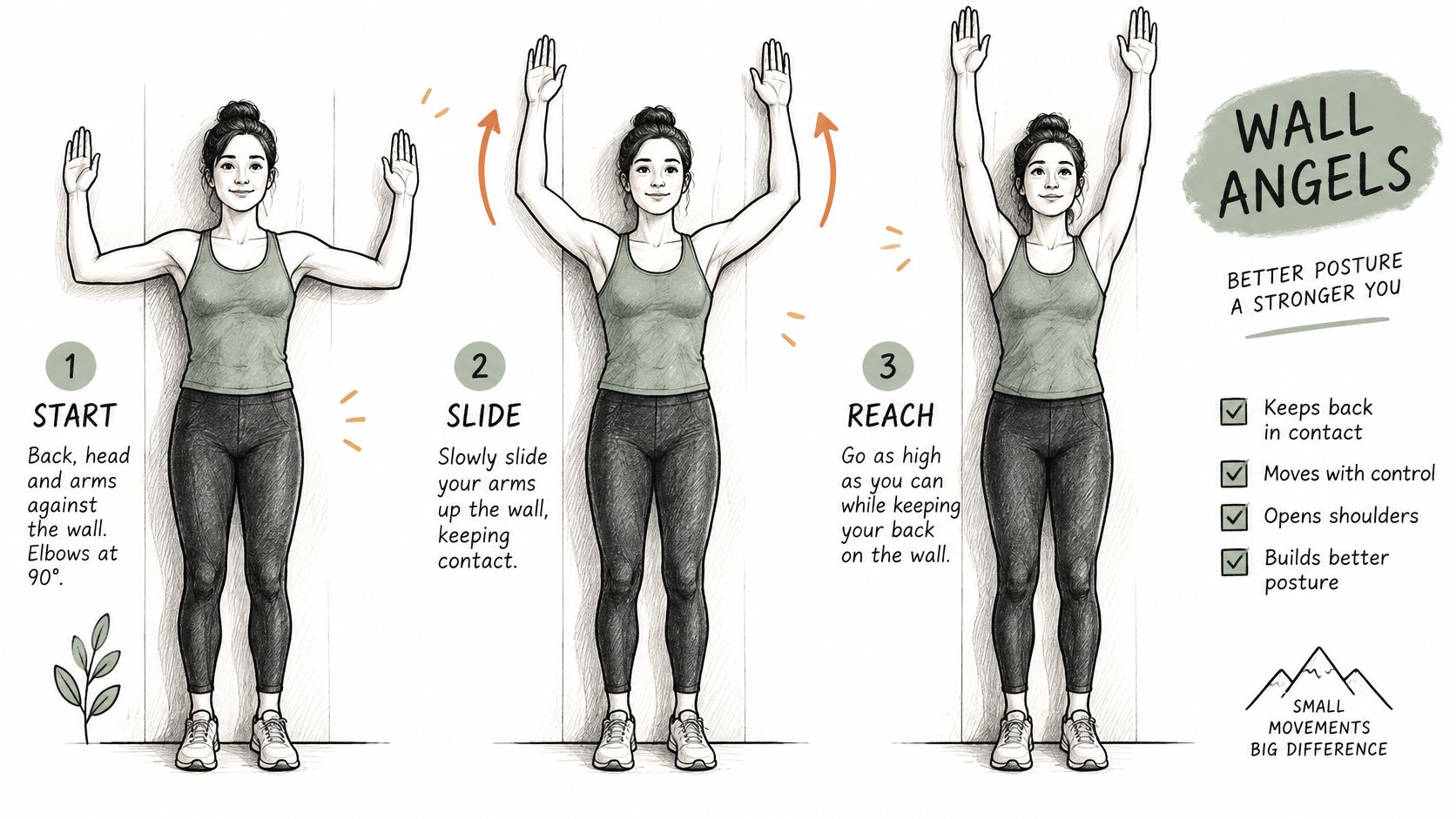
A low back that arches off the wall, ribs that flare, or a pinch at the front of the shoulder means the range is too big. Reduce it. Keep the neck relaxed; jamming the chin back adds the very tension this drill is meant to unload.
Use this table as a quick reference once you have learned each movement above. The dose column summarizes the prescription, but the column that matters most is the last one: every exercise has a stop signal, and respecting it is what keeps a mobility drill from becoming an aggravation.
| Exercise | Postural Driver | Dose | Stop If |
|---|---|---|---|
| Chin Tucks (Deep Cervical Retraction) | Forward head posture | 10 reps; hold 5 seconds | Dizziness, or pain or tingling that travels into the arm |
| Scapular Retraction (Shoulder Blade Squeeze) | Rounded shoulders | 2 sets of 12; hold 3–5 seconds | A pinching sensation inside the shoulder joint |
| Doorway Pectoral Stretch | Tight chest pulling shoulders forward | Hold 20–30 seconds at each arm height | Front-of-shoulder pinch, or numbness into the hand |
| Upper Trapezius and Levator Scapulae Stretch | Overworked neck muscles from head-forward load | Hold 20–30 seconds per side | Headache spike, dizziness, or radiating pain |
| Thoracic Extension Over a Chair or Foam Roller | Stiff mid-back | 5–8 repetitions | Sharp mid-back pain, or the low back doing the bending instead |
| Active Cervical Rotation and Side Bend Range-of-Motion Drill | Lost neck motion | 5 reps in each direction | Dizziness, nausea, or symptoms running into the arm |
| Wall Angels (Scapular Upward Rotation Drill) | Rounded shoulders plus a stiff mid-back | 2 sets of 8–10 reps | Shoulder pinch that persists after shrinking the range, or a low-back arch you cannot control |
A mild stretch sensation and working-muscle fatigue are normal. Anything in the right-hand column is not, and a stop signal that keeps appearing on the same movement tells you that driver needs a hands-on assessment rather than more repetitions.
Split the exercises into two short sessions instead of saving them for one long workout. Morning: 10 chin tucks to reset forward head position, 2 sets of wall angels for shoulder-blade upward rotation, and a doorway chest stretch at three heights for the tight chest that pulls shoulders forward. Midday or after work: 2 sets of scapular squeezes, 5 to 8 thoracic extensions for a stiff mid-back, and 5 slow rotations in each direction to maintain neck motion. Add the levator scapulae stretch in the evening if headaches are part of your pattern.
Ten minutes twice daily beats forty minutes on Sunday. Keep every repetition smooth and stop a drill when it produces pain rather than mild muscle effort or a comfortable stretch. The point is to train the position you carry into the day, not to push through symptoms.
Home exercise has limits. Book an evaluation if neck pain keeps limiting work, sleep, or driving despite consistent home work; headaches keep returning on screen-heavy days; symptoms started after a car accident; or a movement keeps reproducing your usual pain. Treat the arm symptoms, grip changes, and dizziness described with the earlier exercises as reasons to seek care promptly rather than test another routine.
Aspen Falls Wellness offers mobility therapy and posture retraining at its Salt Lake City and Sandy clinics. Chiropractors, massage therapists, acupuncturists, mobility specialists, and nutrition coaches work in one coordinated plan. Dr. Rebekah Patton holds certifications as a Functional Range Conditioning Mobility Specialist and Corrective Exercise Specialist.
If symptoms have not settled, an evaluation can identify whether the main restriction sits in the neck, chest, shoulder blades, or mid-back, or whether care should be referred outside the clinic. Visit Aspen Falls Wellness to book an evaluation in Salt Lake City or Sandy and leave with a personalized take-home plan, with progress re-evaluated as you go.

Stay updated with the latest chiropractic news and exclusive offers.