Master the art of wearing a backpack safely. Learn how to choose, pack, and fit your bag to prevent neck, shoulder, and back strain today.
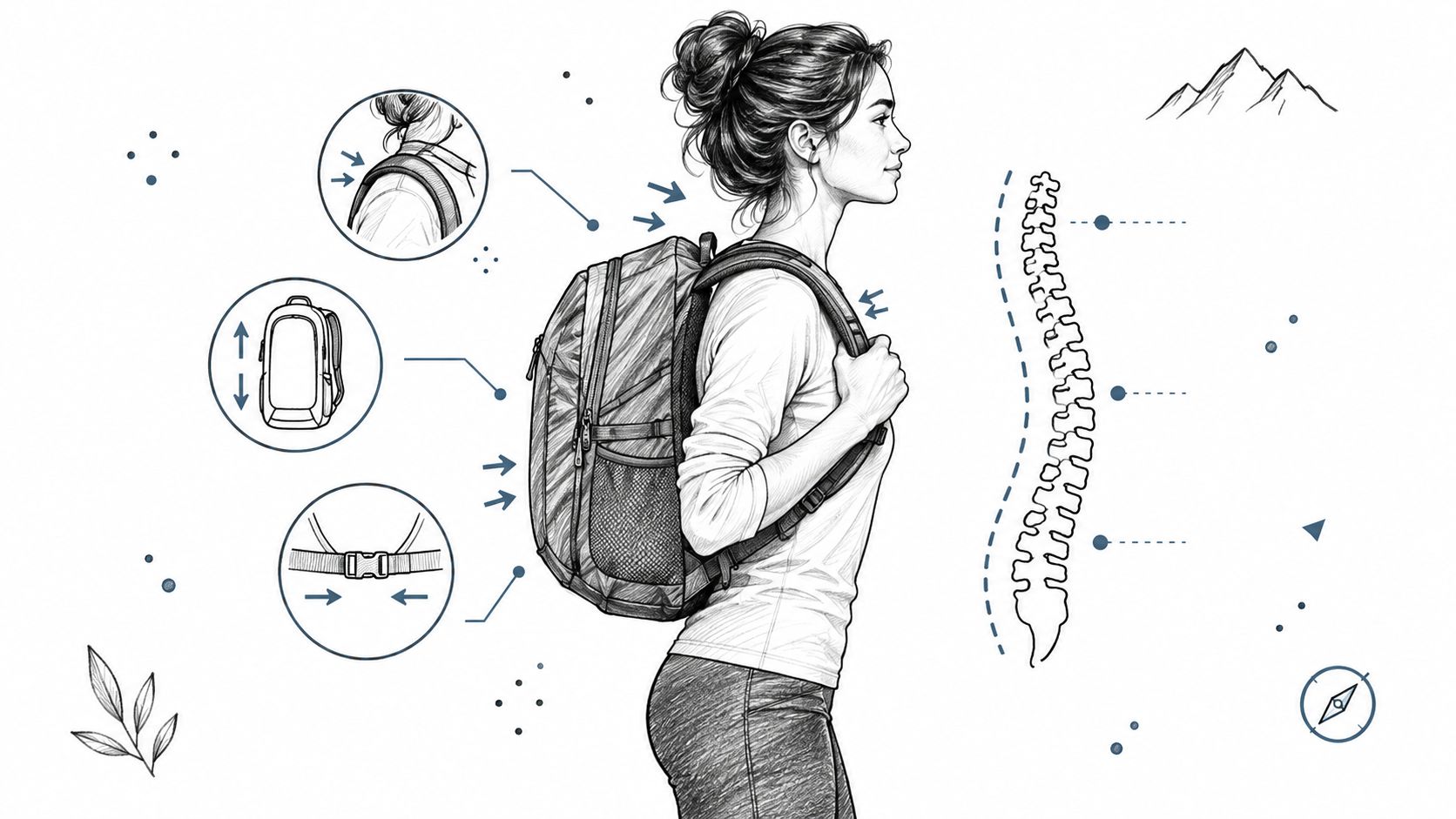
Keep your backpack at or below 10% to 15% of your body weight, but prioritize fitting it high and tight against your torso to minimize pressure on your spine and upper body. For routine walking, 10% is a conservative starting point, especially if you already have neck or back symptoms.
You may be reading this with one shoulder sore, your neck tight, or your lower back aching after a commute, school day, airport walk, or trip through the grocery store. The bag may not feel especially heavy when you lift it, yet it starts pulling you backward within minutes. You tighten one strap, shift the pack to one side, or carry it by the top handle, hoping the discomfort will settle.
Often, the problem isn't weight alone. A dense laptop placed far from your back, loose straps that let the bag hang low, or one-sided carrying can create more mechanical advantage than a better-balanced load. Wearing a backpack comfortably is a load-management skill, not merely a matter of buying a lighter bag.
Backpacks have solved the same practical problem for thousands of years: carrying external weight while keeping the hands free. The oldest known example is associated with Ötzi the Iceman, whose approximately 3300 B.C. Alpine equipment included a wooden frame likely intended to carry a hide sack or net. Modern load distribution developed much later, including Henry Clay Merriam's framed knapsack patent in 1878, Ole F. Bergan's curved metal frame in 1909, and Gerry Cunningham's zippered compartments during the 1930s. By the 1970s, lightweight frames and nylon construction had helped make backpacks common school equipment. (Backpack history)
The design changes tell us something important. A backpack isn't automatically harmful. Its frame, straps, compartments, and belt are attempts to keep the load close, stable, and compatible with walking. Trouble begins when the bag's center of mass sits too far behind you or shifts unevenly while your body tries to preserve balance.
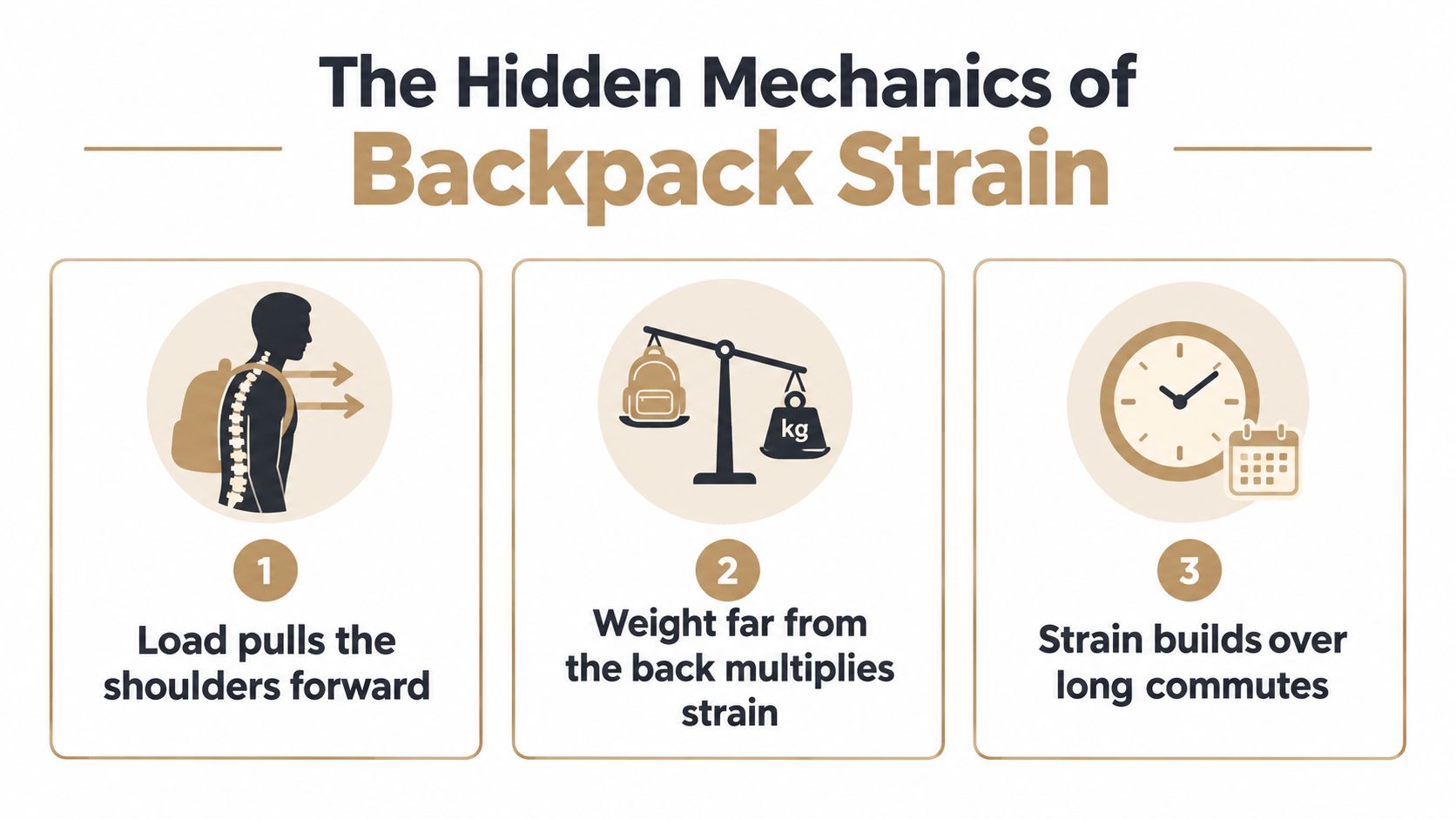
A 15-pound bag close to the spine can feel more manageable than a lighter bag with a laptop, water bottle, and dense equipment pressing outward in an exterior pocket. The farther the weight sits from your body, the longer the lever acting on your shoulders and trunk. Your muscles respond by pulling the shoulders forward, increasing trunk effort, or leaning you into a compensatory position.
Loose straps magnify the problem. When the pack hangs below the lumbar region, it can sway with each step and alter walking mechanics. One-shoulder carrying adds asymmetry, forcing the trunk to compensate laterally instead of sharing the work across both sides.
Practical rule: A manageable backpack should feel centered, stable, and close. If it swings, pulls backward, or makes you lean forward, the fit needs attention even if the total weight seems acceptable.
The evidence also argues against treating the 10% rule as a universal medical cutoff. A systematic review of 69 studies involving 72,627 children and adolescents found no convincing, consistent evidence that backpack weight, design, or carrying method increases the risk of developing back pain, although the prospective evidence was limited and many studies had moderate-to-high risk of bias. (Systematic review of backpacks and back pain)
That uncertainty doesn't make fit irrelevant. It means you should separate short-term fatigue, pressure, altered posture, and discomfort from claims that every backpack symptom represents spinal damage. If your symptoms improve after removing unnecessary items and correcting the fit, mechanical exposure was likely part of the picture. If they persist, the backpack may be revealing a problem that deserves assessment.
Start with the fully loaded bag, not the empty one. A pack that fits perfectly before you add a laptop, books, or work equipment can sit very differently once the center of gravity changes.
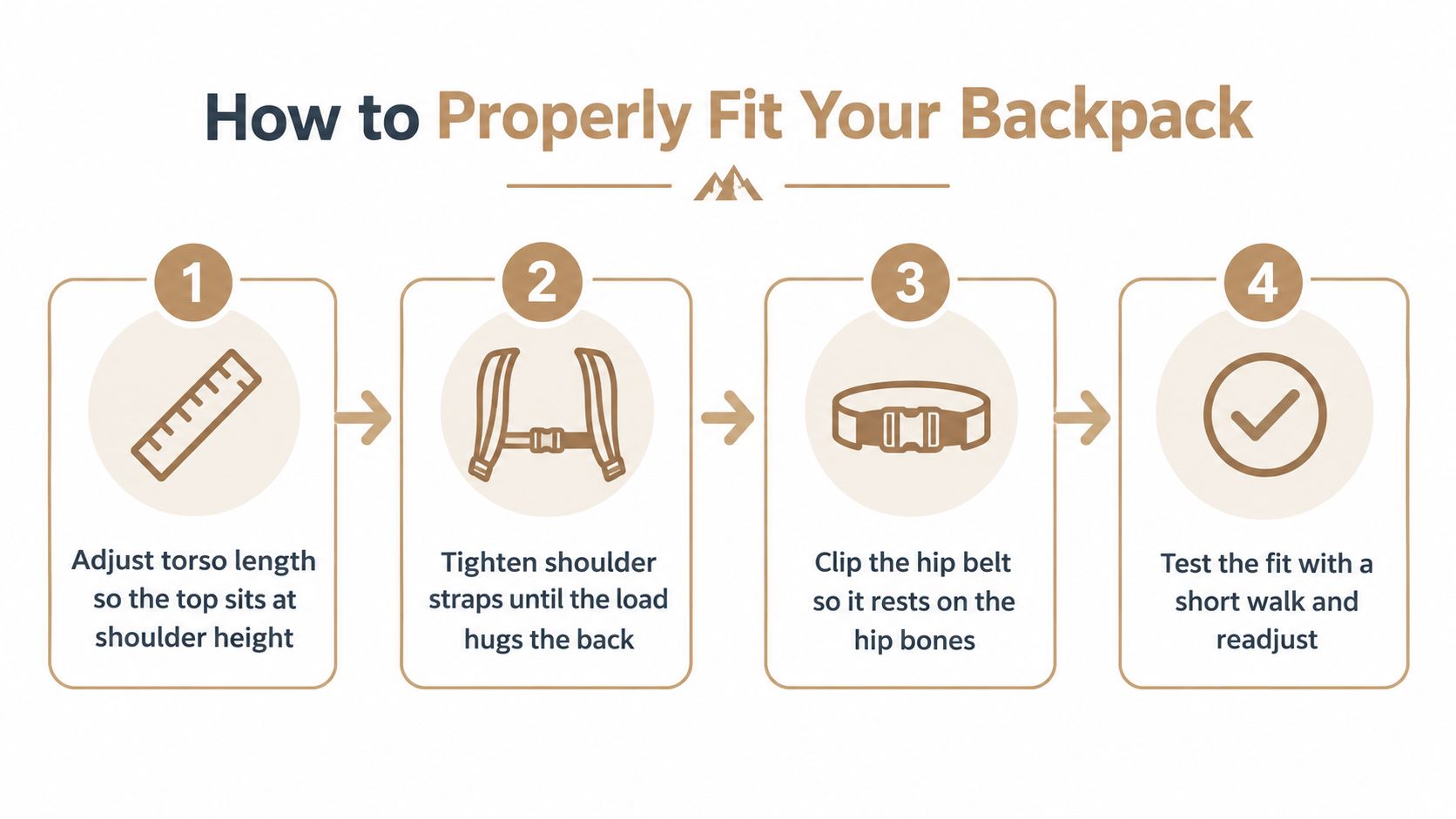
Weigh the complete pack. For routine walking, target no more than approximately 10% of your body weight. Broader ergonomic guidance often places an acceptable range between 10% and 15%, but your symptoms, walking duration, terrain, and conditioning matter. A University of Iowa Health Care example gives a practical reference: a person weighing 150 pounds should carry no more than 15 pounds. (Backpack weight and ergonomics review)
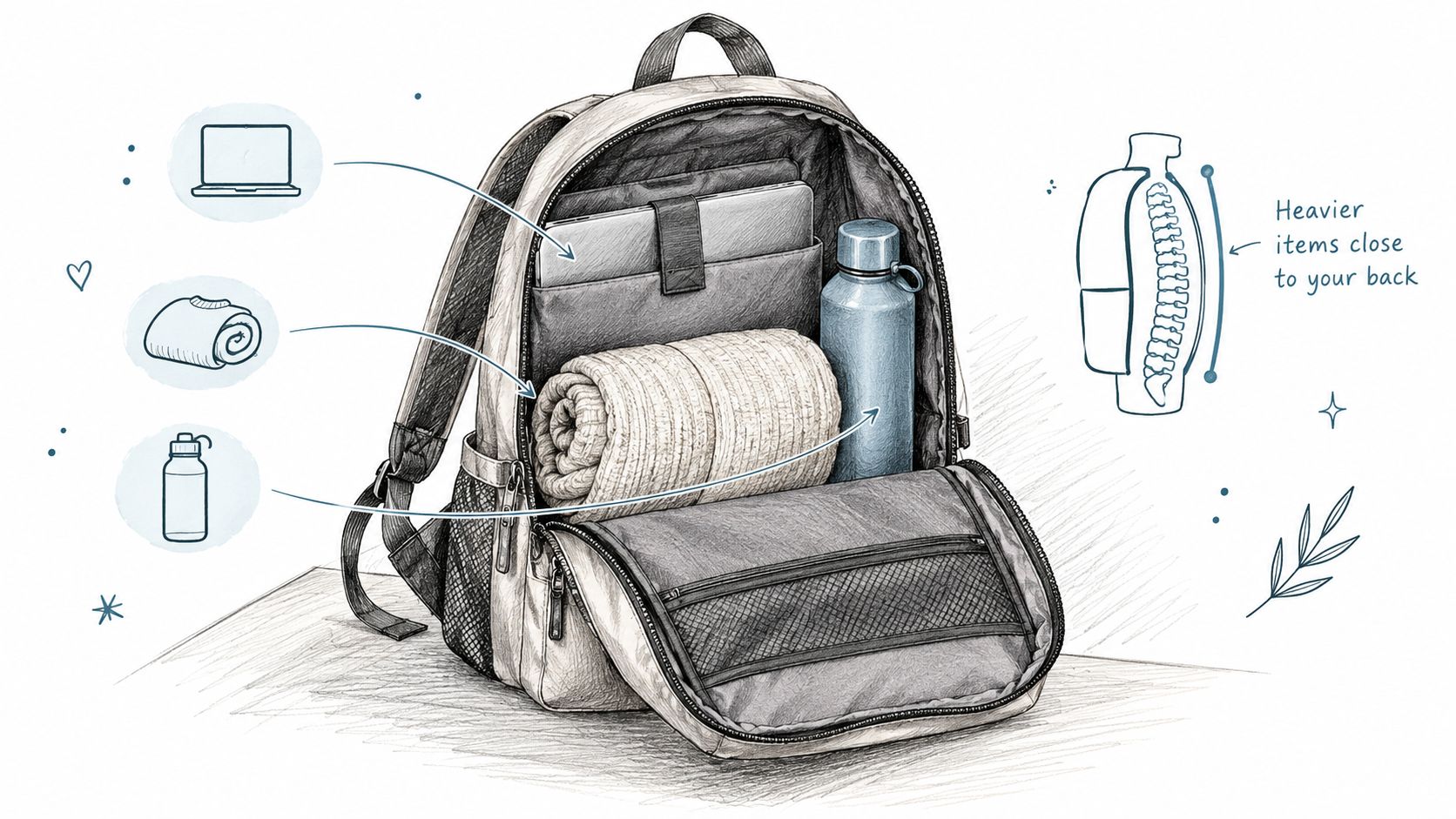
Place dense items close to your spine. Put the laptop, books, or other heavy objects against the back panel and as high on the back as practical. This reduces the backward pull and limits the torque created by weight sitting far away from your torso.
Tighten both shoulder straps. Adjust them until the bag rests high and close instead of hanging low. The straps should hold the pack against you without digging into the shoulders or forcing the neck forward. A chest strap can reduce strap migration, while a hip belt can transfer part of the load toward the pelvis when the pack is heavier.
Walk and reassess. Take a short walk at your normal pace. Notice whether you lean forward, shorten your stride, lose balance, feel pressure on one shoulder, or sense the bag moving independently of your body. Make one adjustment at a time so you know what helped.
A properly fitted bag isn't supposed to immobilize your upper body. It should move with you while remaining stable. A hip belt is especially useful for longer walks, hiking, or a substantial load, but it won't compensate for unnecessary items or poor placement.
Workplace teams can apply the same principles to shared equipment and commuting habits through resources on practical ergonomics for HR teams. For an individual with recurring shoulder symptoms, also review this guidance on shoulder pain from poor posture.
Fitting the straps won't fix a bag packed in a way that constantly pulls away from your body. Packing should control three things: distance from the spine, movement inside the bag, and side-to-side balance.
Put the heaviest item against the back panel first. A laptop belongs in the protected sleeve closest to your torso, not in an outer pocket. Books, dense equipment, and full containers should sit beside or above it when the bag's design allows. Lighter clothing, soft items, and flexible supplies can fill the space farther forward.
Use compartments to stop objects from sliding as you walk. A water bottle rolling from one side to the other creates small repeated corrections, even if the total weight hasn't changed. Those corrections can become noticeable during a long commute, on stairs, or when you move quickly through a station.
The practical packing order is simple:
A bag that's technically within the recommended weight range can still feel harsh if the center of mass sits low and far behind you. Conversely, distributing a heavier load close to your back may reduce the forward pull, although it doesn't remove the need to manage the total weight.
This matters when transporting more than office supplies. If you regularly move sports equipment, tools, or outdoor gear, plan the route and handling method before you load the bag. Guidance on how to haul gear alone can help you think through when a backpack is appropriate and when another carrying method is safer.
A weekly clean-out also reduces exposure. Remove duplicate chargers, old papers, unused clothing, and items you carried “just in case.” If removing those items doesn't improve your symptoms, the issue may be the fit, the duration, or your body's tolerance for loaded walking. You can also review strategies for repetitive strain prevention when backpack use is part of a larger pattern of daily overuse.
Your body begins adapting to a loaded backpack before obvious pain appears. The pack pulls backward, and you may lean forward to keep your center of gravity over your feet. The shoulder straps can draw the shoulders down and forward, while the head shifts to preserve your visual horizon.
The size of the load and the way you carry it both matter. A controlled study of 21 young adults found that a 10% body-weight load carried bilaterally on the back did not significantly alter gait stability, while 20% loads and alternative positions did. A separate study found that longer shoulder straps caused significantly greater discomfort than shorter straps when the pack weighed 15% of body weight. (Biomechanics of backpack fitting and load placement)
A 2023 study found that even a 10% body-weight load altered lower-limb kinetics and kinematics. In a laboratory study of 24 healthy young adults, carrying 25% of body weight in a traditional backpack reduced trunk angle by about 14° and increased head angle by about 13° compared with no load. Those measurements show how the body compensates when the load becomes difficult to control. (Loaded backpack biomechanics)
Walking can also slow, and stride length can decrease with a loaded pack. A systematic review and meta-analysis reported increased craniohorizontal angle during standing, alongside reduced walking speed and stride length during walking with loaded backpacks. If you notice a persistent forward head position, shortened steps, or a marked change in balance, don't dismiss it as ordinary tiredness.
A controlled study of 12 schoolchildren compared loads of 5%, 10%, and 15% of body weight during 10 minutes of treadmill walking. The 15% load produced greater head and trunk flexion, increased associated muscle activation, and a reduced lumbosacral angle compared with the lower loads. (Backpack load and posture study)
These findings explain why a comfortable bag can become uncomfortable after time, speed, hills, or repeated trips. For readers dealing with mid-back symptoms, more context is available in this guide to thoracic back pain.
Most backpack discomfort deserves a practical first response: remove unnecessary items, use both straps, bring the load closer to your back, and shorten the shoulder straps. Then reassess during a short, level walk. If the discomfort settles and doesn't return, the exposure was likely mechanical and manageable.
Persistent or neurological symptoms require a different approach. Stop increasing the load or duration if you develop new or escalating neck or back pain, numbness, tingling, unusual weakness, loss of balance, marked forward lean, or a persistent change in stride. Pain that radiates into an arm or leg, follows trauma, or remains despite fit and packing changes shouldn't be managed by repeatedly tightening straps.
Likely load-related discomfort tends to appear during or soon after carrying, improves when the pack is removed, and changes when you correct the fit or reduce the contents. Shoulder pressure, temporary muscular fatigue, and mild stiffness can fit this pattern.
A possible underlying spinal or nerve issue is more concerning when symptoms continue without the backpack, recur despite a better fit, travel into an arm or leg, or come with numbness or weakness. The pack may be exposing an existing vulnerability rather than causing the entire problem.
One college-student study cited by University of Iowa Health Care reported that 85% of participants experienced discomfort or pain associated with backpack use, but that finding doesn't prove the backpack alone caused every symptom. (University of Iowa backpack guidance)
The same symptom-based reasoning applies to other activities. If you're trying to stay active while managing back discomfort, this run pain-free guide offers a useful reminder to evaluate symptoms rather than forcing activity through escalating pain.
A professional evaluation can identify whether the main problem is fit, restricted mobility, muscular weakness, joint irritation, disc-related pain, or nerve involvement. Seek prompt medical attention for severe or rapidly worsening symptoms, significant weakness, or loss of bladder or bowel control.
Wearing a backpack safely comes down to controlling exposure rather than chasing a perfect product. Weigh the loaded bag, remove what you don't need, place dense items close to your spine, use both shoulder straps, and tighten the pack until it sits high and stable. Add the hip belt when the load or walking duration makes shoulder pressure the limiting factor.
Don't use a percentage as permission to ignore symptoms. A conservative 10% starting point may suit routine walking, while individual tolerance changes with duration, terrain, speed, conditioning, and prior neck or back problems. Increase either load or duration, not both, and only when your walking remains comfortable and symmetrical.
If adjustments don't resolve the problem, the next step isn't necessarily to stop all activity. It may be to assess mobility, strength, posture, and spinal function, then use targeted care such as rehabilitation exercise, mobility therapy, massage therapy, acupuncture, muscle stimulation, or an individualized exercise plan. The right approach should match the cause, not just the weight of the bag.
If backpack use is aggravating recurring neck, back, or sciatica symptoms, visit Aspen Falls Wellness for an individualized evaluation and conservative care plan. The practice offers Chiropractic Adjustment, Spinal Decompression with the DRX 9000, SoftWave Therapy, MLS Laser Therapy, Massage Therapy, Acupuncture, Mobility Therapy, Rehabilitation Exercise, Nutrition Counseling, and related pain relief services for patients in Salt Lake City and Sandy.

Stay updated with the latest chiropractic news and exclusive offers.