Whiplash treatment exercises with safe reps, holds and daily frequencies, the pain limits to respect, and the warning signs that mean get checked first.
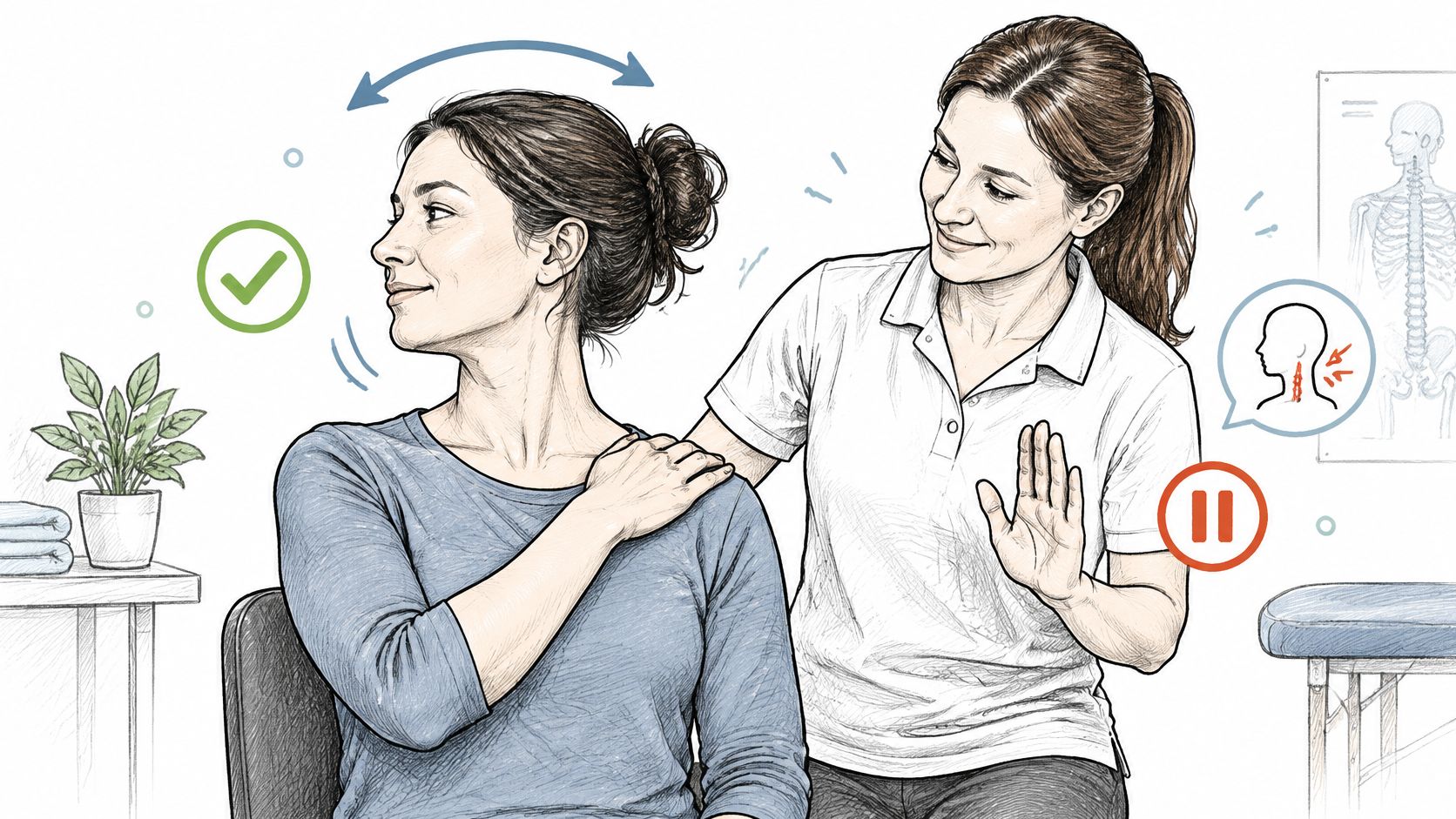
You're trying to turn your head to check traffic, but your neck feels tight after a collision. You've found several exercise sheets, and each gives different instructions: hold the stretch, repeat it more often, or keep everything gentle. It's hard to know which dose to follow, especially when movement hurts.
Whiplash treatment exercises should give you a manageable way back to movement, not another test to push through. The useful questions are which routine fits your symptoms, how your neck responds afterward, and when you need an examination instead of more repetitions.
Whiplash-associated neck pain often follows a rear-end collision. Guided exercise is an active part of conservative care, not a cure on its own: a systematic review of exercise therapy found short-term improvements in pain and medium-term improvements in disability, but limitations in the studies reduced certainty about the size of the benefit.
Timing matters. In acute whiplash, a review of postural and stabilization exercises supported posture work and advice for reducing pain and work disruption, and found stabilization exercises more effective than soft cervical collars in the studies reviewed.
The doses below apply once you've been screened and pain has eased enough to move comfortably. The figures come from the Berkshire Healthcare physiotherapy guide, Leeds Community Healthcare whiplash guidance, and NHS Fife exercise leaflet, respectively.
Whiplash exercise doses by guideline
| Exercise | Reps and Holds | Frequency | Guideline |
|---|---|---|---|
| Neck rotation | 10 to 20 reps | 2 to 3 times daily | Berkshire Healthcare |
| Side-neck stretch | 10 to 20 reps | 2 to 3 times daily | Berkshire Healthcare |
| Upper-body stretch | 10 to 20 reps | 2 to 3 times daily | Berkshire Healthcare |
| Shoulder circumduction | 10 to 20 reps | 2 to 3 times daily | Berkshire Healthcare |
| Upper-cervical flexion, lying down | 10 to 20 reps, 5-second hold | 2 to 3 times daily | Berkshire Healthcare |
| Chin retraction | 10 reps, 10-second hold | 3 times daily | Leeds Community Healthcare |
| Controlled head rotation | 10 reps, 10-second hold | 3 times daily | Leeds Community Healthcare |
| Side-bending | 10 reps | Up to 10 times daily | Leeds Community Healthcare |
| Forward bend, side bend and rotation | Holds of 5 to 10 seconds, up to 10 reps | Every 1 to 2 hours, as pain allows | NHS Fife |
| Shoulder rolls | 5 to 10 in each direction | Every 1 to 2 hours, as pain allows | NHS Fife |
These are alternative prescriptions, not a combined daily target. Don't take the longest hold from one leaflet and the highest frequency from another.
Choose a consistent guideline-based plan with your clinician. If you're cleared to start today, begin at the lower end of that plan rather than treating its maximum as a requirement.
Starting-dose rule: Follow one agreed routine, keep movements gentle, and adjust the dose to your symptoms rather than trying to complete every row.
Mild, temporary discomfort can be acceptable; sharp, spreading, or progressively worsening symptoms aren't something to push through. A stretch that feels tight and then settles is different from a movement that triggers tingling down your arm or leaves you substantially worse afterward.
Research-based whiplash patient guidance explains that moderate pain during activity is unlikely to worsen tissue injury, while excessive restriction can contribute to weakness and delayed recovery. That doesn't mean you should deliberately seek moderate pain, or assume that all symptoms are harmless.
Screening comes first after a collision. Suspected fracture or spinal cord involvement needs urgent medical care, not a home mobility routine.
Use this sequence when you're medically cleared to exercise:
For example, a local pulling sensation during a small head turn may settle when you return to center. Burning that travels into your forearm, especially with numbness, changes the decision even if you haven't completed the planned repetitions.
You don't need to prove you can tolerate a painful session. The purpose is to find a repeatable amount of movement that doesn't produce a sustained flare.
| Symptom | What It May Signal | What to Do |
|---|---|---|
| Arm weakness, numbness or tingling | Possible nerve involvement | Stop the affected exercises and arrange medical assessment promptly |
| Pain that spreads or radiates down the arm | Nerve irritation | Stop the movement and book a clinical review |
| Sudden, severe or worsening headache | Needs medical evaluation | Seek urgent medical care |
| Severe dizziness or balance problems | Possible vascular or neurological cause | Stop exercise and get assessed the same day |
| Clumsy hands, trouble walking or bladder changes | Possible spinal cord involvement | Seek emergency medical care |
| Pain that stays worse for several days | Dose too high or other cause | Reduce the dose and arrange reassessment |
These signs don't establish a diagnosis by themselves. Sudden or marked weakness, rapidly worsening neurological symptoms, or difficulty walking warrant urgent assessment rather than waiting for a routine appointment.
Delayed soreness after a collision doesn't automatically mean you need imaging, but persistent or worsening symptoms deserve review. Our guide to what to do after car accident neck pain explains the practical next steps after an accident.
Prolonged rest, fear-driven avoidance, and relying on a collar aren't substitutes for assessment and graded activity. If a clinician has prescribed immobilization for a specific injury, however, follow that instruction rather than removing support yourself.
Keep the current dose when symptoms settle back to baseline by morning. If they don't, reduce the dose and arrange a review; any red flag overrides the home exercise plan.
Choose a quiet space, a stable chair, and enough room to lie down. Keep each movement small and controlled: the aim is to practice the motion without adding force or chasing the end of your range.
The illustration provides visual cues. The steps below explain how to position your body and avoid common technique errors.
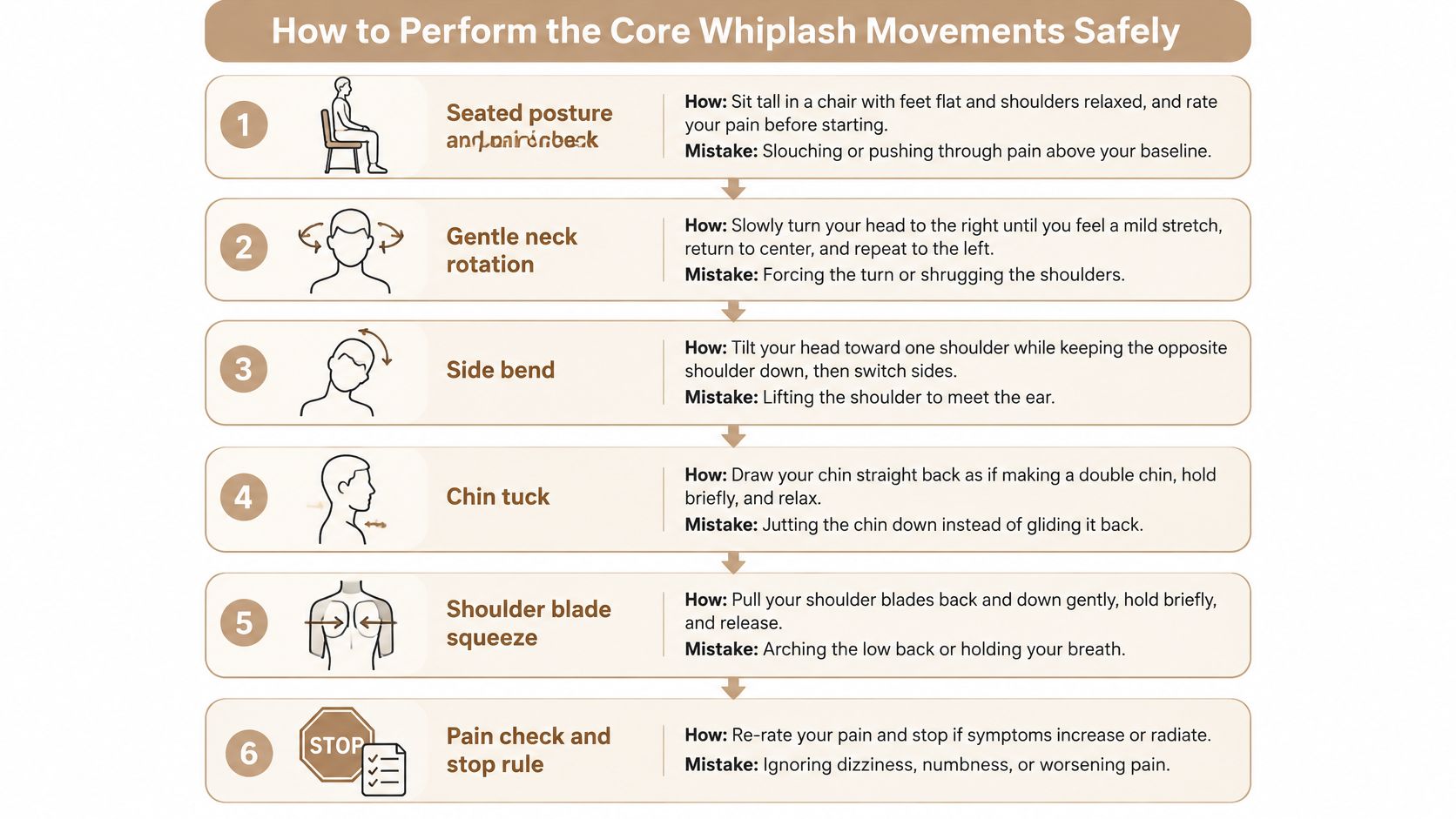
Seated posture and pain check. Sit upright with both feet flat, shoulders relaxed, and eyes facing forward. Note your pain from 0 to 10 so you can compare how you feel before and after practice. This rating is a record, not a target to push through.
Chin retraction. Glide your chin straight backward, as if making a small double chin, and follow the Leeds hold and repetition dose in the table. Keep your gaze level. If the chin glide turns into a nod, reduce the range until your head moves straight back.
Controlled rotation. Turn your head slowly toward one side, pause for the prescribed Leeds hold, then return to the center before turning the other way. Follow your clinician's directions for dividing the repetitions between sides. Keep the movement smooth rather than forcing the endpoint or making circles, which NHS Fife advises against.
Side-bend. Tilt one ear gently toward the same-side shoulder, then return to upright and switch sides using the Leeds repetition target. Keep the shoulder lowered; lifting it or pulling your head with your hand changes the movement.
Shoulder rolls. Circle both shoulders smoothly, then reverse direction, following the NHS Fife dose. Use a comfortable, modest circle. If you find yourself bracing your neck or arching your back, make the circle smaller.
Lying upper-cervical flexion. Lie on your back with your head supported. Gently draw your chin inward to lengthen the back of your neck, following Berkshire's hold and repetition range. The head stays on the surface; avoid lifting it or pressing it down.
Breathe normally as you move. A clenched jaw, held breath, or urge to pull harder usually means the motion has become too effortful, so ease back and make it smaller.
Focus on comfortable control. Each repetition should look and feel steady, like tracing the same small path rather than stretching farther each time. Your range may remain limited at first; smooth, repeatable movement is more useful than forcing extra distance.
Afterward, compare your symptoms with your starting point and note which movement felt difficult. That record can help a clinician review your technique and adjust the exercise plan.
It's easy to assume that adding more stretching or strengthening should produce steady recovery. When that doesn't happen, you may blame your effort rather than question whether the program matches your limitations.
A systematic review of exercise for whiplash-associated disorders found broad general-exercise programs weren't meaningfully better than brief advice in the medium term; both groups improved by roughly 7% in pain and 7.4% in disability. Extending a generic routine isn't a reliable answer to persistent symptoms.
Neck-specific exercise can produce better pain responses than prescribed general physical activity in some people with chronic whiplash. But adding more components doesn't automatically improve results: a 2025 systematic review and meta-analysis of 13 studies involving 2,427 participants found no overall difference between neck-specific exercise alone and neck-specific exercise combined with a behavioral approach.
Make these changes this week if your program has stalled:
Our explanation of therapeutic exercise describes how purposeful movement differs from staying busy.
Sleep disruption and fear of movement also deserve discussion. Addressing them doesn't mean your pain is imagined, and it doesn't require attaching the same behavioral program to everyone.
Better targeting beats a longer checklist. When progress stalls, review selection, technique, progression, and recovery barriers before adding more exercises.
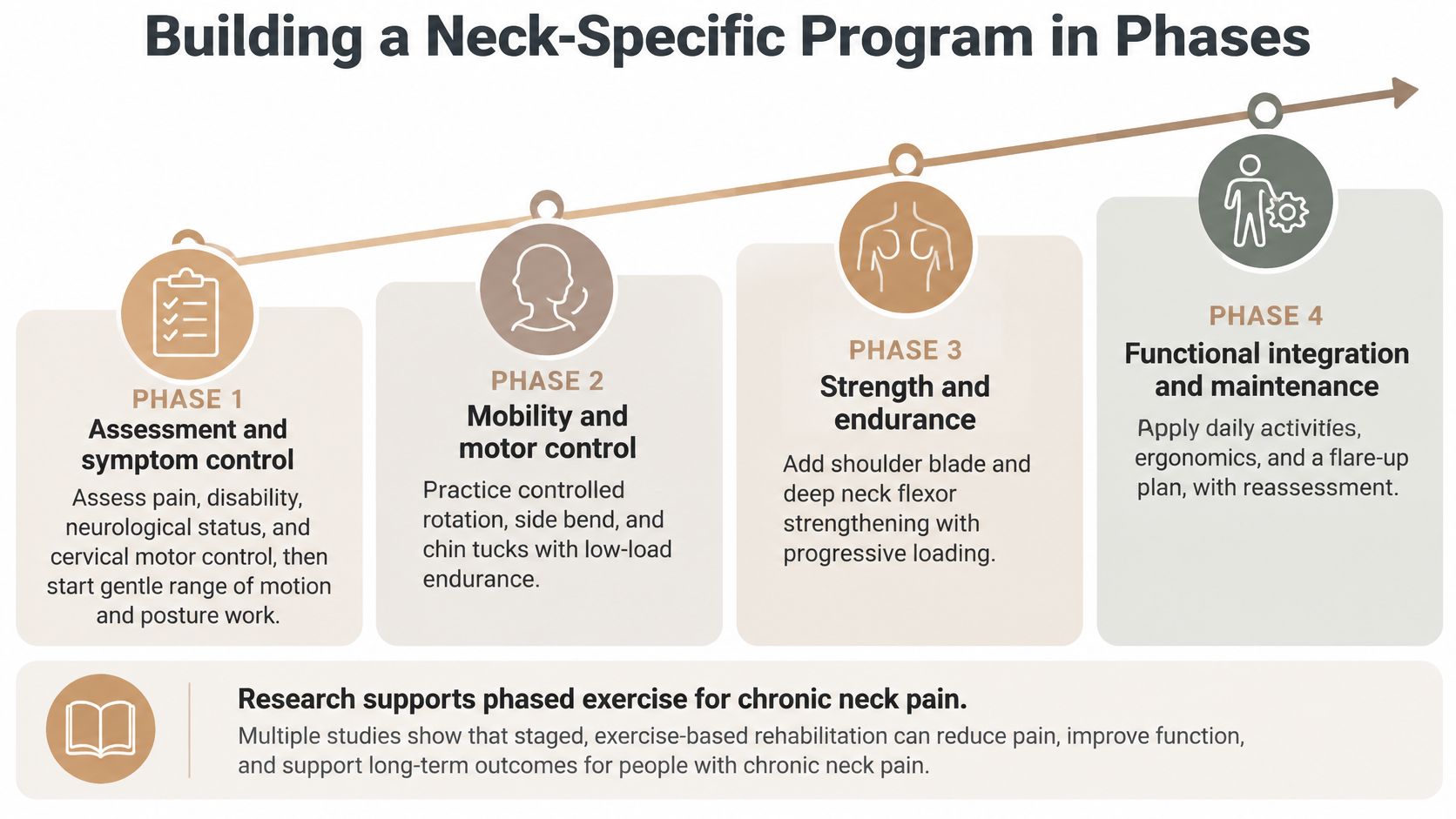
A chronic-stage exercise program should develop in steps, with each phase preparing you for the next. The starting point is an assessment of pain, disability, neurological status, cervical motor control, and exercise tolerance. These findings help a clinician select an appropriate starting level rather than hand you a standard strengthening sheet.
The infographic shows a route from assessment toward everyday function. It is a guide, not a deadline: progress depends on how your symptoms and movement respond.
Start with low-load activation. Gentle work for the deep neck flexors and shoulder-blade stabilizers builds control. Continue only while you can keep the movement steady within your symptom limits.
Then develop controlled mobility. Increase cervical range gradually as pain allows, stopping before you force through a stiff endpoint. Once you can move with control, build endurance by adding sustained work or repetitions while maintaining your technique.
Functional strengthening comes later. Introduce resistance and movements that reflect everyday tasks in manageable steps. If neurological symptoms, dizziness, or radiating pain worsen, stop that progression and seek assessment rather than pushing through.
A randomized trial of chronic whiplash-associated disorders found that 29% to 48% of participants in neck-specific exercise groups achieved at least a 50% reduction in pain bothersomeness at 3 months, compared with 5% in the prescribed general physical-activity group. In the same trial, approximately 70% to 71% achieved at least 50% attendance, while adherence at 6 months was roughly 52% to 55%. These results offer useful context, not a promise that everyone will respond the same way.
Use a written log to connect exercise with function. Record whether you completed the session, how your symptoms responded, and whether a relevant daily task became easier. A technique review can help clarify whether you are ready to move on, for example, if you can complete the current movement without shrugging your shoulders.
In a randomized trial of mobile-app support after whiplash, median adherence at 6 months was 3 versus 2 on a four-point scale (p = 0.005), and pain catastrophizing decreased by 31%. There were no significant between-group differences in Neck Disability Index or pain intensity. Reminders may support participation, but completing exercises alone does not show that the dose is useful.
Hands-on care, such as massage therapy for whiplash, can be discussed alongside an active program. Let movement quality and symptom response guide progression, rather than advancing because the next phase is listed on a sheet.
Confirm your plan with a clinician before increasing it, particularly if pain persists after several weeks of home exercise or any warning sign appears. Red flags need the appropriate urgent medical pathway, not a routine appointment to advance strengthening.
An examination helps distinguish a dosage problem from a condition that needs different management. It also gives you a clear explanation of what you're working toward and how to judge progress.
Begin with a full initial examination and diagnosis, with X-ray or MRI referral when indicated. Imaging isn't a prerequisite for every exercise plan; the examination determines whether referral is appropriate.
The clinician should then review pain, disability, neurological findings, and movement control. Be specific about what happens during daily activities: whether pain builds at your desk, turning your head brings on arm symptoms, or your neck tires during ordinary tasks.
At Aspen Falls Wellness, our diagnosis-based customized plan may combine chiropractic adjustments, rehabilitation exercise, mobility therapy, and personal exercise plans, and may include DRX9000 Decompression and/or MLS Laser Therapy when appropriate to the diagnosed condition. These options aren't interchangeable, and a whiplash diagnosis doesn't automatically mean you need device-based treatment.
We evaluate patient progress with each adjustment and tailor treatment to stay on track toward optimal spine health. Dr. Jeremy Kaier received extensive training in The McKenzie Method, Motion Palpation technique, and various soft tissue techniques, and specializes in treating herniated discs, stenosis, and sciatica.
You don't need a perfect diary to make an appointment. Even a short account of which movements help and which leave you worse can make the review more useful.
Leave with clear expectations about what to practice, what to pause, and when your progress will be checked. Your exercise dose should move with your symptoms and function, not according to the calendar.
Aspen Falls Wellness offers car accident assessment, mobility therapy, and individualized rehabilitation exercise for people in Salt Lake City and Sandy. Visit Aspen Falls Wellness to book an evaluation and build a whiplash exercise plan with clear doses, progression targets, and stop rules.

Stay updated with the latest chiropractic news and exclusive offers.